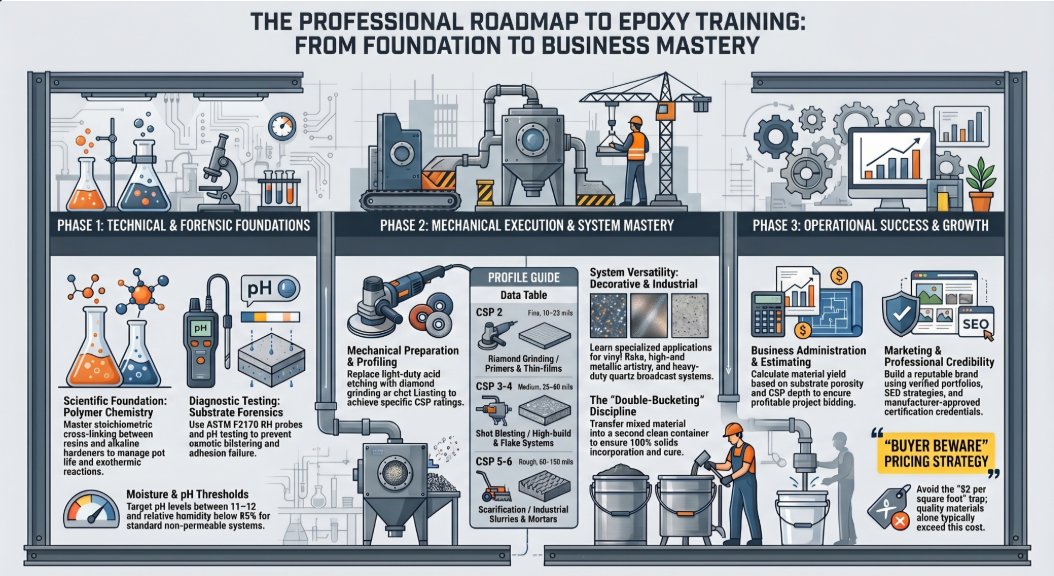
The epoxy flooring industry is consistently growing as homeowners, businesses, and industrial facilities prefer durable and attractive floor coating systems. This demand has created new opportunities to build a career in the flooring industry.
However, it is very important to get proper epoxy flooring training for success. Many courses claim to teach epoxy installation, but not all programs offer the same level of education, hands-on experience, or business guidance.
If you are about to take epoxy flooring training, it is important to understand the difference between a professional training program and a basic workshop. This guide explains the important factors to evaluate before enrolling in a program.
Why Proper Epoxy Flooring Training Is Essential
Epoxy flooring may look simple at first, but the installation process requires technical knowledge, attention to detail, and practical skills.
Epoxy is a two-part system made up of resin and hardener. These components must be mixed correctly and applied under suitable conditions. Even a small mistake can affect the final result.
Some of the most common installation mistakes include:
- Poor surface preparation
- Incorrect mixing ratios
- Moisture-related issues
- Uneven application
- Insufficient curing time
These errors can cause peeling, bubbling, discoloration, or coating failure. A professional training course helps students understand both the science and application techniques behind successful epoxy flooring systems.
Rather than making expensive mistakes on real projects, students develop practical skills in a controlled training environment.
Check Whether the Course Covers Multiple Epoxy Systems
Some projects need different types of flooring systems.
A versatile installer can serve a wider range of customers and take advantage of more business opportunities. For that reason, a strong training program should cover several types of resinous flooring systems.
Systems Worth Learning
- Flake Systems: These systems are commonly installed in garages, workshops, retail spaces, and commercial facilities. Decorative flakes improve appearance while adding texture and durability.
- Metallic Epoxy Floors: Metallic systems create unique surface patterns that resemble marble, stone, or flowing water. Metallic pigments are manipulated by using specialized tools such as air blowers, solvents, or heat guns to create rich, layered, three-dimensional finishes. These floors are popular in showrooms, offices, and luxury residential spaces.
- Quartz Broadcast Systems: Quartz floors are known for their durability and slip resistance. They are often used in food processing facilities, healthcare environments, and industrial settings.
- Solid Color Coatings: Solid-color systems remain a popular choice for warehouses, manufacturing facilities, and commercial properties.
- Moisture Barrier Systems: These specialized systems help prevent coating failures caused by moisture vapor transmission from concrete slabs.
The broader your skill set, the more projects you can confidently complete.
Assess the Instructor’s Industry Experience
The instructor plays a major role in the quality of your learning experience. An experienced instructor brings practical knowledge gained from years of working in the field. They understand real-world challenges and can share solutions that students may not find in manuals or online videos.
When researching a course, consider the following questions:
- How many years has the instructor worked in the industry?
- Have they completed residential and commercial projects?
- Are they still active in the flooring business?
- Do they have experience with multiple flooring systems?
Experienced instructors often share valuable insights that help students avoid common mistakes and improve project outcomes.
Make Sure Surface Preparation Is Included
You should never trust a course that skips the essential preparation work. Professional installers know that surface preparation is the most important factor for a long-lasting bond.
Ensure the curriculum includes:
- Mechanical Grinding: Using diamond tooling to open concrete pores.
- Moisture Testing: Learning ASTM standards like In-Situ Relative Humidity (RH) probes.
- Crack Repair: Using epoxy injection or polyurea to fill defects.
- PH Testing: Checking for chemical contamination or acid exposure.
Many DIY failures happen because people assume a simple mop or acid wash is enough. A professional course teaches you how to achieve the correct Concrete Surface Profile (CSP) required by the manufacturer.
Advice: Smaller class sizes often provide a better learning experience. With fewer students, you’ll have more opportunities to ask questions, receive personalized feedback, and gain hands-on practice during application exercises.
Comparison of Common Resinous Coating Systems
Understanding these systems helps students select the right product for each project.
| Coating Type | How It Cures | Key Advantages | Potential Limitations |
| 100% Solids Epoxy | Exothermic crosslinking of resin and amine hardener | High dry-film thickness; excellent chemical, abrasion, and stain resistance | High viscosity; sensitive to outgassing; low moisture permeability |
| Water-Based Epoxy | Water evaporation and polymer coalescence | Low VOC emissions; highly breathable and vapor-permeable | Limited film build; reduced chemical and abrasion resistance |
| Solvent-Borne Epoxy | Solvent evaporation and polymer crosslinking | Superior surface wetting; excellent adhesion to challenging substrates | High VOC emissions; strong odor; ventilation and respiratory protection required |
| Polyaspartic | Rapid aliphatic polyurea/urethane reaction | Extreme UV stability; rapid cure times for fast return to service | Short pot life; sensitive to humidity; high material cost |
Business Training Is Just as Important as Installation Skills
Technical skills alone are not enough to run a profitable operation. A comprehensive course must include business administration. You need to know how to:
- Price Jobs Correctly: Factor in labor, overhead, and material waste.
- Estimate Materials: Calculate the exact amount of resin needed based on floor porosity.
- Marketing & Leads: Build an online presence, manage SEO, and use digital campaigns to find customers.
- Sales Strategy: Learn how to bid on jobs and overcome client objections.
Ask About Support After the Course
Completing a training course is only the beginning.
As learners begin working on projects, new questions often arise. Access to ongoing support can make a significant difference during the early stages of a career.
Some programs offer:
- Technical assistance
- Phone support
- Refresher resources
- Networking opportunities
- Industry updates
Being in connection with experienced professionals after the training can provide valuable guidance when unexpected challenges occur.
Questions to Ask Before Enrolling (Your Checklist)
Before you commit your tuition, use this checklist to evaluate the quality of the program:
- Is the training conducted on real concrete?
- Does the course teach mechanical preparation (grinding)?
- Will I learn moisture testing and diagnostic standards?
- Does the curriculum include business, marketing, and pricing modules?
- Is there post-training support or a helpline?
- Who is the instructor, and what is their field experience?
Why Choose Epoxy Classes in Upstate New York
In the Northeast, specialized training centers in Upstate New York, including Johnstown, offer a practical, hands-on learning environment. These programs are designed for both beginners and existing contractors, providing a hands-on learning environment that covers multiple epoxy systems. These classes’ small group instruction and real-world application questions help local professionals build a strong foundation for long-term success.
In Closing
When you have to choose the right epoxy flooring training course, you should not only consider the cost. The best programs provide thorough chemistry education, mechanical preparation skills, and business literacy. By investing in a hands-on certification program, you are not just learning a skill; you are gaining qualifications that can support your career development.